

Online orders close on 29th September
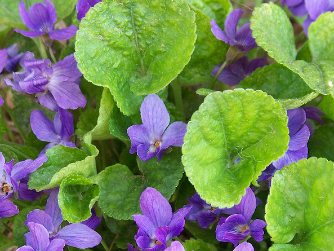
Viola odorata (Sweet violet) 9 cm Pot
Hardy, low-growing perennial with heart-shaped leaves and richly fragrant purple flowers. Still used today in skin-soothing preparations and researched for anti-inflammatory, mucilage-rich and antioxidant activity.
Description
Growth habit & appearance: Viola odorata forms a compact, ground-hugging clump of dark green, heart-shaped leaves that emerge early in the season. Its intensely fragrant violet or deep purple flowers bloom in late winter to early spring, providing essential nectar for early pollinators when few other plants are in flower. As a woodland-edge species, it spreads gently via runners, forming small drifts that contribute to biodiversity-rich understories and shaded garden habitats.
Growing conditions: A fully hardy perennial well suited to Irish shade conditions, Sweet Violet thrives in partial to full shade and prefers moist, humus-rich, well-drained soil. It naturalises easily in cool, temperate climates and will self-seed on disturbed or open ground, slowly expanding into soft carpets of foliage and flowers. Its shade tolerance makes it ideal for underplanting beneath deciduous shrubs and hedges.
Traditional & herbal uses: Traditionally used for skin conditions, Sweet Violet has a long history in soothing topical preparations and gentle mucilage-based remedies. Modern research highlights its anti-inflammatory, antioxidant and emollient properties, linked to salicylates, saponins, cyclotides and phenolic compounds. Contemporary herbalists still employ the flowers and leaves for mild inflammatory skin disorders, dry or irritated tissues, and to support lymphatic stagnation. Sweet Violet’s cyclotides also feature in current pharmacological studies exploring cell-protective and wound-modulating potential. Ecologically, its early-flowering habit makes it a critical forage plant for pollinators emerging at the end of winter.
Maintenance & harvesting: Harvest flowers as they open for best aromatic and medicinal quality. Plants can be divided to expand colonies or rejuvenate older clumps. Keep soil lightly mulched with leaf litter to maintain moisture in shaded sites. Because it spreads by runners and seed, occasional thinning may be needed if a tight boundary is required. Beyond this, Sweet Violet requires little attention once established.
Reviews
There are yet no reviews for this product.